How to Maintain a Clean Home When You’re Not the Only One Living in It
There’s a version of “clean home” that only exists in Pinterest photos.
And then there’s the real version — the one with juice cups on the coffee table, someone’s hoodie on the dining chair, a half-finished school project, and a partner who somehow never sees the crumbs on the counter.
Maintaining a clean home when you live alone? Easy.
Maintaining one when you share it with kids, a partner, and all the personalities that come with them? That’s strategy.
And a little emotional maturity.
Let’s talk about it.
1. Redefine What “Clean” Means in a Shared Space
If you’re the one who notices everything — the fingerprints, the crooked rug, the random sock — you’re probably carrying most of the mental load too.
But here’s the truth:
A home with people in it will never stay “magazine perfect.”
Instead of aiming for spotless, aim for:
- Functional
- Reset daily
- Clutter-controlled
- Sanity-preserving
Your house should feel lived in — not like a staged showing.
2. Stop Quietly Resenting — Start Clearly Assigning
One of the biggest mistakes we make?
We assume everyone sees what we see.
They don’t.
Instead of:
- Re-cleaning something angrily
- Making passive comments
- Waiting to see if they “notice”
Try this instead:
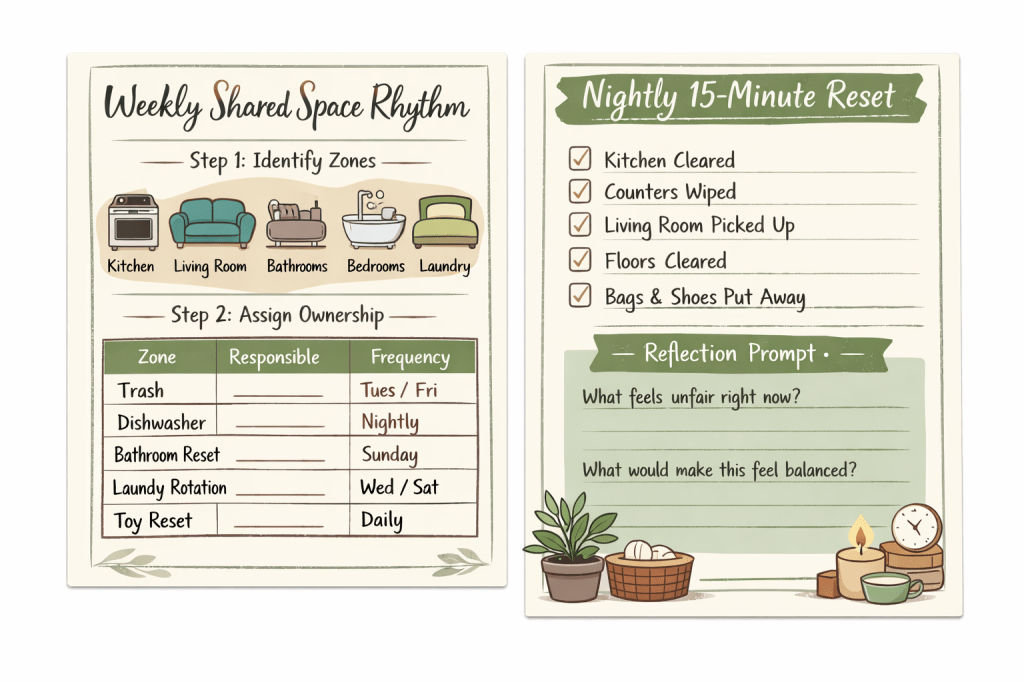
- Assign zones (bathroom, trash, dishes, laundry rotation)
- Make expectations visible
- Be specific
Not “help out more.”
But:
- “Please empty the dishwasher every night.”
- “Trash goes out every Tuesday and Friday.”
- “Shoes don’t live in the hallway.”
Clarity > resentment.
3. Create Systems That Work for the Messiest Person
This is a game changer.
If your partner drops keys everywhere?
→ Put a key tray by the door.
If your toddler dumps toys?
→ Open bins, not tiny labeled containers.
If your teen leaves laundry on the floor?
→ Hamper in the exact corner they drop it.
Design around behavior — not fantasy.
4. The 15-Minute Night Reset Rule
This rule saves relationships.
Every night:
- 5 minutes in the kitchen
- 5 minutes in the living room
- 5 minutes picking up visible clutter
No deep cleaning.
No martyr energy.
Just reset the main spaces.
You wake up to calm instead of chaos.
And calm changes everything.
5. Have the “Shared Space” Conversation
Your home isn’t just your responsibility.
It’s a shared environment.
Have the grown-up conversation:
- “I feel overwhelmed when I’m the only one maintaining this.”
- “Can we figure out a rhythm that feels fair?”
- “What feels manageable for you weekly?”
It’s not about control.
It’s about respect.
6. Protect One Space That’s Yours
This one is important.
Maybe it’s:
- Your nightstand
- Your closet
- Your bathroom counter
- Your side of the bed
Claim one area that stays exactly how you like it.
When everything else feels shared, you need a small pocket of control.
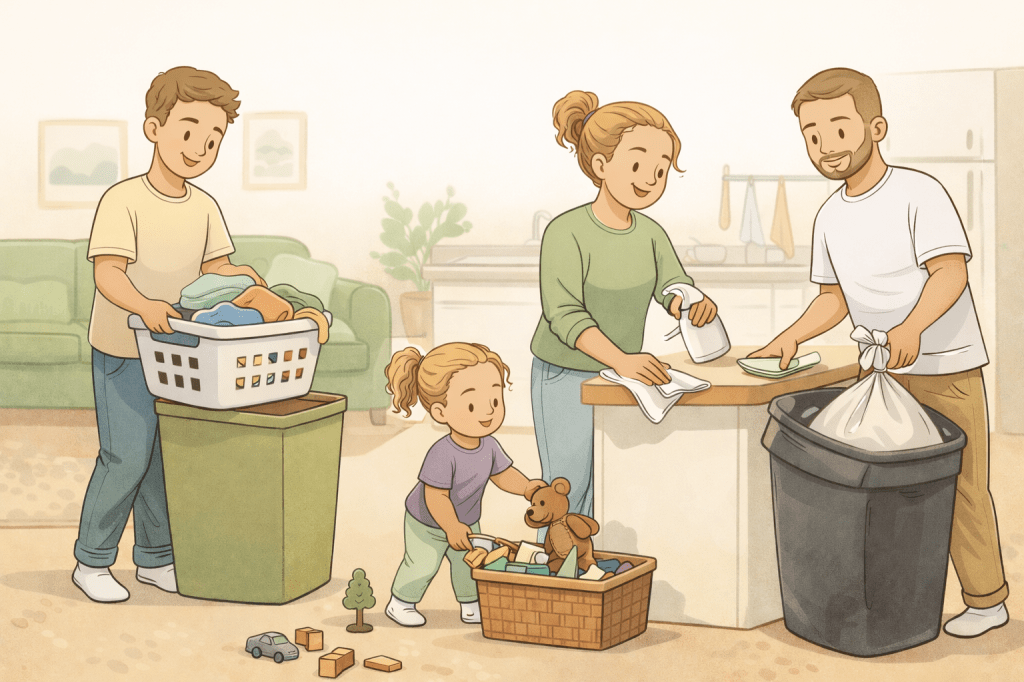
7. Teach Kids Early That Cleaning Is Living
Cleaning is not punishment.
It’s maintenance.
Normalize:
- 3-year-olds putting toys away
- Teens doing their own laundry
- Everyone clearing their own plate
Not because you’re strict.
But because you’re raising functional adults.
8. Release the “I’ll Just Do It Myself” Trap
You might do it faster.
You might do it better.
You might do it without reminders.
But if you always take over, you train everyone to let you.
Let them:
- Fold towels imperfectly.
- Load the dishwasher wrong.
- Miss a spot.
Progress > perfection.
Real Talk
A clean home with kids and a partner isn’t about spotless floors.
It’s about:
- Systems
- Communication
- Boundaries
- Shared responsibility
You don’t need a bigger house.
You need better rhythms.
And maybe a labeled bin or two.
Reflection Question for You
What’s one small system you could put in place this week that would remove 20% of your frustration?
Start there.
Small shifts change shared spaces.
—
If this resonated, share it with another mom who’s tired of being the household project manager.
You deserve help.
You deserve peace.
And yes — you deserve a clean-ish house too.

 Notes By Kae
Leave a comment